How the ‘emerald necklace’ became a green barrier
—Mike Worobec—
Few cities in the world are so intellectually and aesthetically deliberate as Edinburgh.
The capital’s New Town was not an accident of growth, but an act of vision; an Enlightenment city carved in stone. The great Georgian planners did not merely build houses, they composed a landscape. Streets, crescents and squares were aligned with almost musical precision, each opening onto sweeping prospects down to the water, across to distant hills, into light.
This was urban theatre. Order. Clarity. Air.
And crucially, greenery was part of that composition; not as wilderness, but as ornament. The gardens formed what might be called Edinburgh’s ‘emerald necklace’; a sequence of cultivated green spaces, carefully held within the geometry of the city.
These were not forests, nor were they meant to be. They were curated. But today, that curatorship has been lost.
Unchecked growth
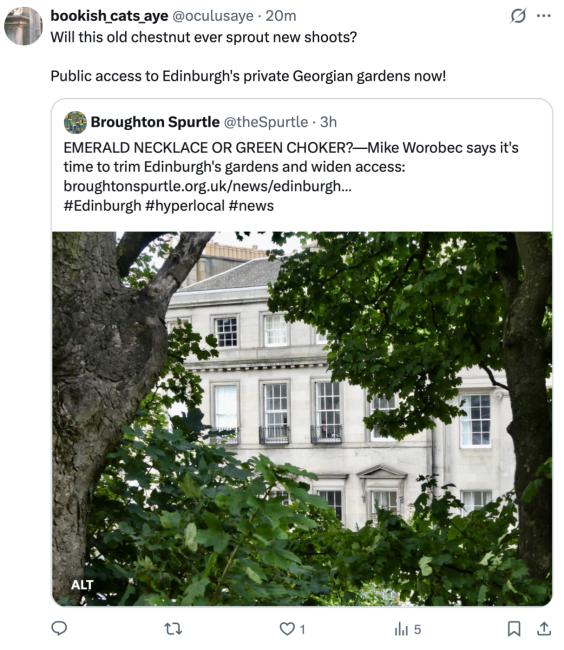
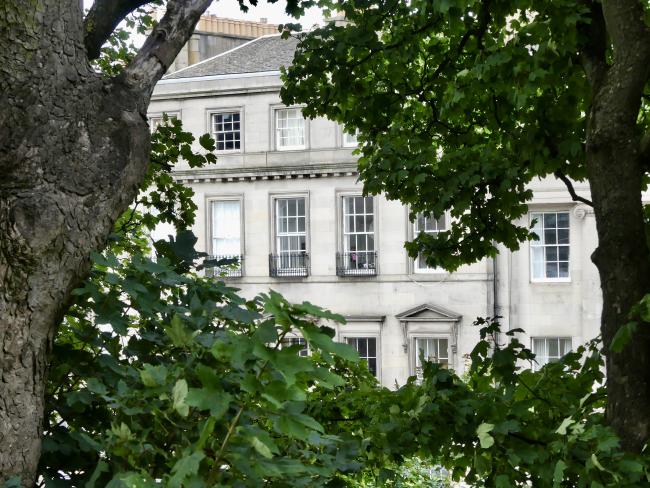
Over decades, Edinburgh’s New Town gardens have been allowed to grow unchecked. They are no longer landscapes but thickets. Trees have surged upwards and outwards, self-seeded growth has taken hold, hollies and dense understorey have crowded out light and space. What were once open lawns and framed views have become heavy, impenetrable masses.
The result is not romantic. It is obscuring. The great vistas – those defining lines of sight that once swept towards the Firth of Forth – have been quietly erased. Where there was perspective, there is now blockage. Where there was light, there is shadow. The city’s architecture – designed to be seen in full, glowing in northern light – is dulled, its facades half-lost behind a wall of unmanaged green.
Green barriers
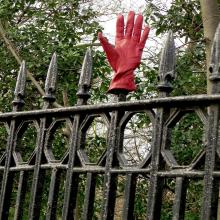
These spaces now function less like gardens and more like barriers.
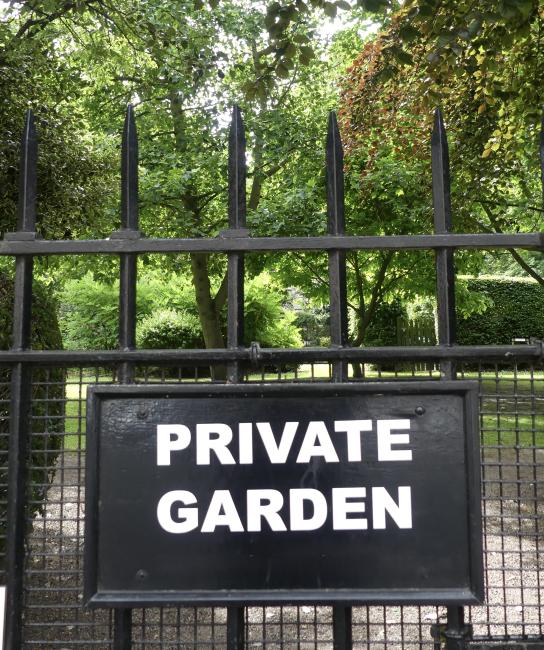
In a modern capital, this raises a practical question as well as an aesthetic one. These vast, largely inaccessible enclosures cut through the heart of the city, forcing pedestrians to navigate around them. They interrupt movement, limit permeability and create dead zones where there could be life, connection and flow.
And yet, paradoxically, they are barely used. Stand at their edges and look in. There is seldom anybody there. No sense of shared civic space. No animation. Just density.
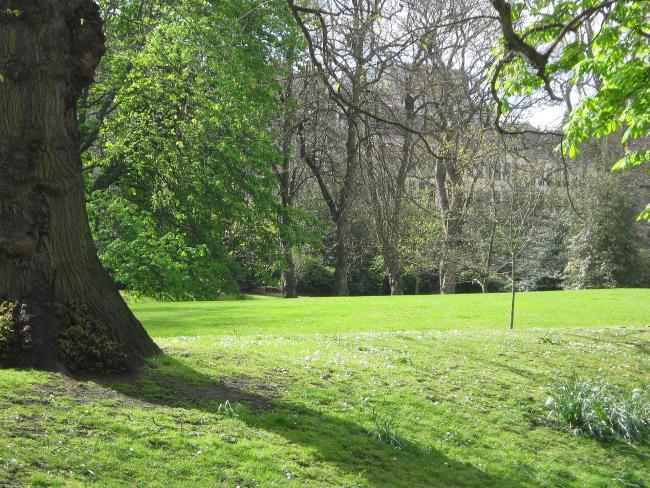
[Image: Brian McNeil, Wikimedia Commons.]

Absence of stewardship
This is not an argument against trees. It is an argument against neglect. The current condition is not ‘natural’; it is the absence of stewardship.
The Georgian designers understood nature deeply but they shaped and framed it. They controlled scale, light and proportion with the same discipline they applied to stone. What we see today would have been alien to them: a rural overgrowth imposed upon an urban composition.
Left unchecked, the problem is not only visual. Many of these trees are now overmature, crowded, competing for light and increasingly vulnerable. Without active management, failure is inevitable; and when it comes, it will be sudden, costly and potentially dangerous.
Curating access
Edinburgh deserves better than passive decline disguised as greenery.
What is needed is a return to curatorship: a long-term, expert-led programme to restore these gardens to their intended character. It will require selective thinning, reinstatement of open lawns, reintroduction of sightlines and proper arboricultural care.
And also, crucially, greater public access, with thoughtfully designed paths which allow people to move through, not just around, these spaces.
Vision
Imagine it: walking across the city through light-filled gardens rather than skirting their edges. Imagine seeing again the long, elegant views that define Edinburgh’s identity, reconnecting architecture, landscape and people.
This is not about turning back the clock. It is about finishing the job the Georgians began. Because at present, Edinburgh’s ‘emerald necklace’ no longer adorns the city. It chokes it.
******