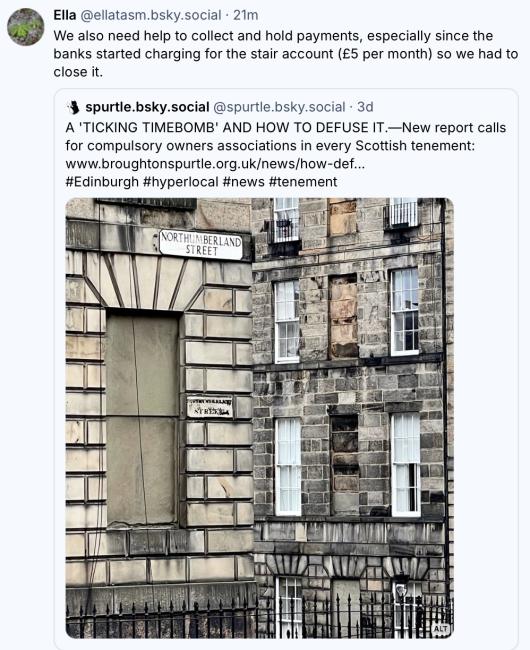
Following publication of a Scottish Law Commission report and draft legislation commissioned by the Scottish government, two built-environment bodies are calling for a new law to make owners associations in tenements compulsory.
In a statement released yesterday, Under One Roof (UOR) and Built Environment Forum Scotland (BEFS) say tenement buildings (defined in Scotland as any building divided into 2 or more related flats under separate ownership) comprise around 37% of all housing stock north of the border. But much of it is in a ‘significant state of disrepair’.
They therefore welcome the SLC’s proposals for creating an owners association in every tenement to make organising repairs and maintenance easier and more timely.
Improved processes with wider implications
Associations would ensure flat owners had ‘the communication, structures, and processes in place to organise repairs in common areas of their building’, for example the stair and roof.
Repair contracts would be signed by owners on behalf of the association, not signed by one or two owners in a private capacity. This would avoid responsible owners having to chase neighbours for their share of the bill, or getting lumbered with the expenses of others unwilling or incapable of paying at all.
The draft law would require owners to:
appoint a manager for the association;
hold one or more meetings each year;
agree a budget for repairs;
supply building information to property registers.
UOR’s Mike Heffron, who describes the condition of Scotland’s tenements as ‘a ticking timebomb’, also calls for buildings to be inspected every 5 years, with each association holding a reserve fund.
BEFS’s Hazel Johnson points to the connection between effective tenement maintenance/improvement and ‘delivering Scotland’s housing needs, net-zero economy, well-being, and more – for many years to come.’
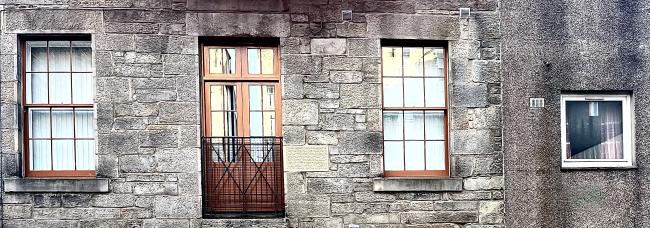
‘Endemic failure’
A separate BEFS publication by Douglas Robertson, Why Flats Fall Down, says that of tenements constructed before 1919, 66% require critical repair and 33% need both critical and urgent repair.
Nearly 50% of tenements built between 1964 and 1982 are in critical disrepair with 20% requiring critical and urgent attention.
Some 25% of tenements built since 1982 are in a state of critical disrepair, with 8% needing urgent attention. The figures reflect ‘an apparently endemic failure of property maintenance’.
In Broughton, many householders could also attest to the poor build-quality of recent housing developments.

UPDATE (14.12.25)
Spurtle has been taking soundings about this story since we first posted it on Friday. Local opinion seems divided.
Some people welcome the proposed legislation, saying it is long overdue. They favour measures which put the social and collaborative aspects of tenemental living on firmer practical, financial and legal foundations.
Others we’ve spoken to are highly suspicious of the potential involvement of ‘managers’. How does one begin to trust the ability or honesty of a neighbour taking on this role? Who would want to take on personal liability in this position?
What about professional factors? Those with personal experience of them in Edinburgh and Glasgow say they charge extortionate fees (which rise year on year) for nothing at all or work which doesn’t need to be done.
Some argue that even with compulsory membership of an owners association, one can’t force people to cooperate meaningfully or set aside money for a ‘building reserve fund’ which they don’t have or want to apportion for this purpose.
Notwithstanding the SLC’s assertions, one person we talked to expressed doubts about Holyrood’s legislative competence to replace the contract between customer and contractor with one between an owners association with ‘personality’ and contractor. They said this would be a matter only Westminster could enact.
For more on this topic, see Dennis O'Keeffe's article here.
Got a view? Tell us at spurtle@hotmail.co.uk.
----------