The redoubtable Victorian brothel-keeper Katherine Johnson featured in Series 6 of the BBC's A History Through Time, which looked at the story of 20–22 Calton Hill.
Johnson enjoyed considerable commercial success and notoriety in her day, working under a variety of names at various addresses.
In the North Briton (Saturday, 24 November 1866), we encounter her as Clara Johnson, working from premises on Clyde Street and involved in a dispute about money with one of her employees.
CLAIM AGAINST CLARA JOHNSON.
Flora M. Young, 2 Rose Street, sued Mrs Clara Johnson or Wilson, Clyde Street, as follows:—
Oct. 22. To money due by you to me, which I handed to you installments, commencing on 6th July last, and ending this date, as per the cash book kept by you, and presently in your possession, £45 0 0
By board and lodging, at 21s
per week, fifteen weeks, £15 15 0
By washing, at 4s per week, 3 0 0
By money for dresses, &c., 7 10 0
26 5 0
£18 15 0
Restricted to £12.
Mr M‘Donald appeared for the pursuer, and Mr Douglas for the defender.
For the defence, Mr Douglas stated that there was no use mincing the matter, the lady he represented kept a brothel in Clyde Street, and the pursuer was a girl of the pavé. There were many objections that could be taken to the present claim, but he would merely state that the defender was a married woman, and could not be sued in her own name, and further, that the house formerly possessed by her now belonged to her sister, to whom she had handed the good will of the name.
Mr M‘Donald said that the name of Clara Johnson, well known over Europe, if changed for that of a husband, was something like a blessing, for he did not think a man could be found who would marry such a wife. He had some doubt as to this marriage, and he held in his hand evidence to that effect.
Here was a letter written by the defender to the pursuer, in which she acknowledged being due the pursuer £4, 3s 9d, also having in her possession clothing to the amount of £12 9s. In this letter she writes to the pursuer about her books and her business in such a style as a baker or a grocer to his customer, and signed it with the name so well known to the police, “C. Johnson.”
This was hardly like a married woman, but as it was possible some fool might have taken her, rather than risk the girl’s claim, as the man could not possibly be found, he would accept decree for the balance stated in the letter, £4 3s 9d, on condition that Mr Douglas would promise at the bar that the articles of dress therein enumerated would be given.
This was agreed to and decree passed accordingly.
We may state for the benefit of our readers that the sum represented in 15 weeks as admitted to have been paid to Clara Johnson by the girl, is only one-half of her earnings, as, according to the contract, Clara gets one half, the girl the other, off which the girl has to pay £1 1s a week for board and lodging, 4s. a week for washing, and so much per week to Dr Henderson, who visits the house every Monday and inspects the inmates. It will thus be seen, from the letter which we give below, that the £39 16s admitted, represents in round numbers, £80 earned by one girl in 15 weeks.
30 Clyde Street, Edinburgh,
15th November 1866.
To Miss Flora M. Young.
Madam,—I was very much astonished to receive an account to-day of £12, said to be due by me to you, and a summons to the Sheriff Court for said amount. You must know that I have never refused to reckon up our books, and pay you whatever may be owing to you.
I have been out of town for some time, and have only returned this week, and I have been waiting for you to call, in order that might settle with you. I did not know your address, and consequently could not send for you.
I have looked up my books, and find that our accounts stand as follows:—“Due to me at last reckoning, 4th July 1866.—Board, dress, two wrappers, chemises, petticoats, stockings, &c. £7 12s; borrowed in my absence, £4 8s 3d; boar, doctor, washing, &c., &c., £18 15s; new pink silk for dress and making, £4 17s—total, £35 12s 3d as per contract; money received from you at different times, £39 16s; deduct £35 12s 3d, leaves a balance £4 3s 9d due by me to you, and which, I beg to inform you, you can receive whenever you choose to call for it.
I shall, of course, be obliged to put the matter into the hands of my lawyer, and I warn you that you would be liable for all my expenses that may be incurred. I shall be at home to-morrow and Saturday between the hours of ten and two o’clock.—Yours, &c.,
C. Johnson.
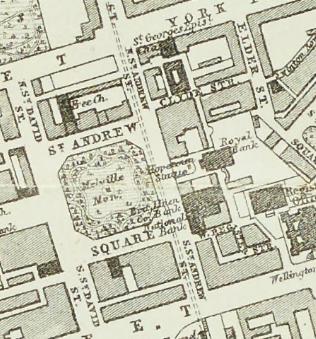
[Map: John Bartholomew, Plan of Edinburgh & Leith with Suburbs, 1864.]
From the North Briton (Saturday, 8 December 1866).
THE SOCIAL EVIL IN EDINBURGH.
TO THE EDITOR OF THE NORTH BRITON.
SIR,—The many numerous readers who perused the Sheriff Court report of last Saturday in the North Briton, could not but be startled and horrified at the revelations it contained in the report of the case against Clara Johnston [sic], the brothel-keeper, or in plainer words, the wife of a Reverend J. Wilson.[1]
Your report has naturally enough drawn out public sentiment, and many have been the comments passed upon the conduct of this woman and her infernal vocation.
Save for the outspoken, fearless exposition now and again given in your columns to such hideous instances of vice and corruption, the good Christian people of our time-honoured Edinburgh, would remain ignorant of much that calls loudly for interference, and be under a state of “blessed ignorance” of the vice and sin rampant in our midst in its vilest forms.
The case which you published last Saturday week affords another instance, of the many unknown instances, of the enormity of the traffic of prostitution, modernised and timidly described under the gentle epithet of “social evil.” In your candour and impartiality you are regardless of personality or exposure where the object deserves it; and it were better, indeed, on many occasions that we had your contemporaries aiding you in exposing such crying instances of vice than giving us a couple of columns of the prosy speech of some presbyterian pedant.
You have again held up to to public scorn this prevailing vice, and in your “Miserrima,”[2] which it would be well for every man in Edinburgh to read, we have a very truthful and outspoken delineation of the characters of prostitution, of its haunts and votaries! You give to the heads of our families, as a beacon of terrible warning; for this subtle vice, with its baneful influences and gilded temptations, is a dread to many an anxious mother, as it has been the ruin of many a happy home.
It is perfectly enormous the amount of money this nefarious traffic realizes in this city. In the case which you reported last Saturday of this girl Flora M. Young v. Clara Johnson, the prima donna of the profession, we have the admission of this brothel-keeper herself, that this grisette had made, in fifteen weeks, upwards of £80,[3] the single return of one girl; and when there is a dozen, as in this house, why, the aggregate weekly return to the mistress of the den must be upwards of £150.
This is the mere earning of these nymphs, and is the smallest share of what this woman makes. The consumption of wine, brandy, &c. is beyond description, and off this additional traffic she will clear her £50 a week.
These calculations are amply supported by evidence, by her own admission, and the more tangible confirmation that at this moment this Clara Johnson—this minister’s wife—has no less a sum than £14,0000 at her credit in a bank, besides an annual return from acquired house property of several hundred pounds.[4]
Here then is the state of our society—of church-building, church-going, religious Edinburgh—and let me ask who are the votaries of this vile profession? Why, sir, their name is legion. And we have in this notorious house no less a person than a reverend gentleman as the husband of this excellent woman. This is a truth beyond question, and can never be refuted. The lord and master of this “establishment of young ladies” is none other than a young minister about 26 years of age, whom I have heard proclaim from the pulpit that he was appointed ambassador of Christ, and who I have heard expound the gospel of our Saviour to many sincere and worshipping Christians, having only left this temple of sin a few hours, where he had composed his sermon and written it.
Are we, or can we now, believe in the professions of all we are told, or of all we hear preached in the house of God? Would that we could answer the question.
Did time permit me, I would have quoted instances of base clerical hypocrisy: and I maintain it is a duty we owe to public morality to expose such heartless wickedness and holy mockery as has been manifest in this reverend saint.
I believe the couple now seek to hide their shame in some elegant villa near London; and on her recent visit to Edinburgh, that the husband’s happiness may be as recherche as possible, she purchased a handsome brougham wherewith to enjoy themselves in the elite society of London, leaving Edinburgh with “her blessing” and the “good will” of her business, which will be carried of by her sister, at 30 Clyde Street, as formerly.
So much then for the Rev. J. Wilson, and I shall look forward with considerable anxiety for his reappearance in some handsome church as the pastor of some Christian worshipping congregation in the great metropolis.—I am, &c.,
MONITOR.
[1] Edinburgh & Leith Post Office Directory (1864–65) lists 2 people with this name in Edinburgh at the time: (1) Rev. James H. Wilson, Barclay manse, 10 Gilmore Pl; (2) Rev. John M. Wilson, 14 Montgomery St.
[2] Miserrima was a book combining social documentary, moral commentary and salacious detail. In it were covered 'the marriage of Clara Johnson; young harlots in the police court; shebeens and their keepers; the modern prostitute's progress – the story of a gay woman; a story about a book folder; localities of the social evil, description of houses of ill-fame; low brothels and their frequents; how brothels are got up; the economy of the brothel; daily life in a brothel; a tour of the chief brothels; harrying a brothel; houses of ill fame in Rose Street; phases of sly prostitution; the milliners and dressmakers; continued growth of the social evil; promoted to be a prostitute; Continental prostitution described; procures; dress houses; the bully; at Clara's; High Street women; women seducers; intemperance; story of a ballet girl; free-trade in the social evil; causes of prostitution; prostitution as a profession; the social evil in America,; an American horror; prostitution in Paris'. It was published at ! shilling by Henry Robinson of 11 Greenside Street and went through several extended editions
[3] A milliner at this time could earn about £8 per year.
[4] £14,000 is equivalent to £2m today. The general price for the services of a 'high-class' prostitute was £5 per night.
Topics
Location