The ‘coffee cave’ phenomenon – why Books n’ Cups works
Charlie Ellis
Books n’ Cups, on Raeburn Place in Stockbridge, is consistently busy. This success puzzles even some regular customers.
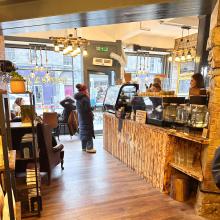
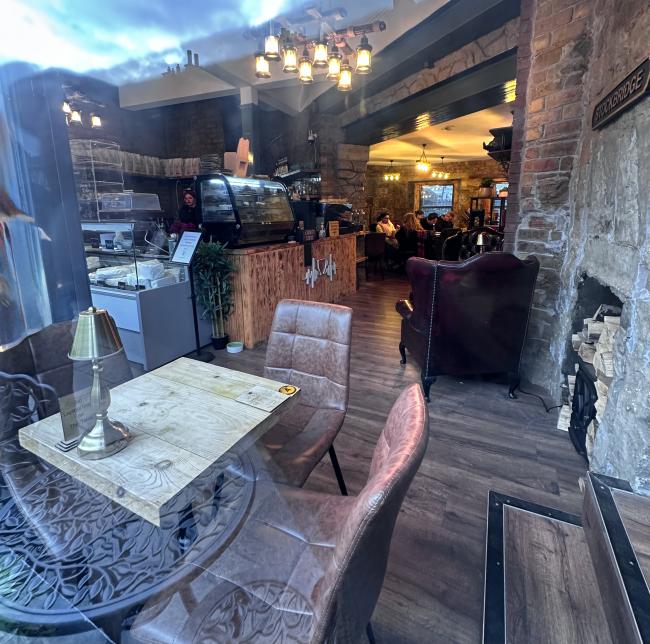
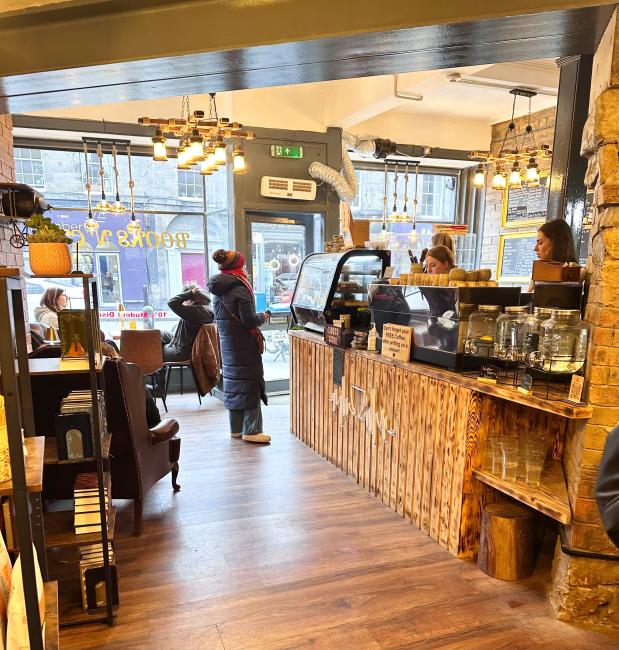
Lacking the elegant Scandi minimalism of Edinburgh’s coffee elite, the space, with its exposed brickwork, leather seating and general ‘homely’ feel, is reminiscent of a pre-Third Wave ‘coffee cave’ circa 2005.
My initial impressions were shaped by utilitarian clutter: a dominant customer counter, an exposed and unattractive pipe and an aesthetic which felt cobbled together rather than carefully curated. Yet its popularity is undeniable.
This piece attempts to understand why the café succeeds by looking beyond coffee quality to its social function.
The coffee: style, substance and the low bar
As someone interested in specialty coffee culture, what struck me most was not the coffee itself but customers’ attitudes towards it.
The drinks preferred at Books n’ Cups are revealing. While the menu is espresso-based, customers overwhelmingly order drinks where milk far outweighs coffee.
This contrasts sharply with contemporary coffee aficionados, who opt for shorter, espresso-forward drinks such as cortados and piccolos, or pour-over coffee: the choice of true enthusiasts who value how careful brewing draws out the deeper subtleties of the beans.
Books n’ Cups is not courting that clientele. They are not competing for members of Edinburgh’s espresso elite – those who might otherwise frequent Cafen on Dundas Street.
Customer reviews confirm this. The most frequently mentioned drinks are lattes, hot chocolates and mochas, often flavoured, such as the ‘Black Forest Latte’, which one customer declared the ‘best latte’ they had ever tried. Mochas receive similar praise.
A coffee snob might say Books n’ Cups is firmly rooted in the past, when such drinks seemed novel and sophisticated, a step beyond ‘white or black’.
More tellingly, this seems connected to lower expectations about quality. One review captures it neatly: ‘Lovely little coffee shop. My coffee on this day however was a little on the weak side, but they were very busy. Have been there on other occasions and it’s been fine.’
Customers avoid technical terms such as ‘under-extracted’ or ‘poorly dialled in’. They describe coffee as ‘weak’ or, more damningly, ‘fine’. For a drink costing well over £3.00, that is a modest benchmark. They could get something far better for their money elsewhere.
The point is clear. People who go to Books n’ Cups are not seeking meticulously calibrated, high-end coffee. They are going for something else.
A democratic and inclusive ‘Third Place’
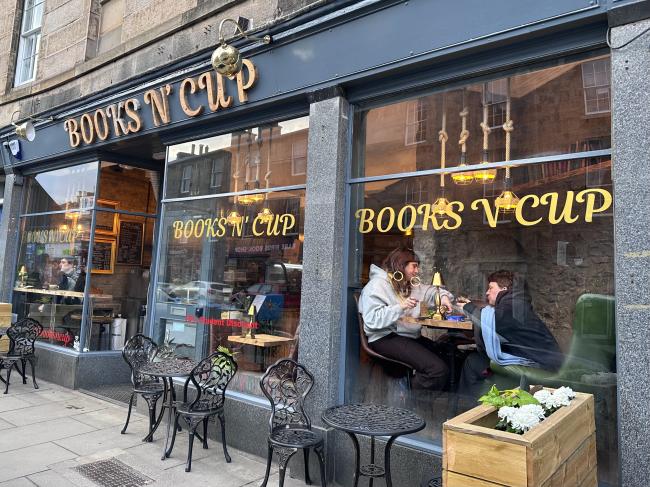
The café’s first major strength is that it is genuinely democratic.
Unlike some of Edinburgh’s specialty coffee spots, which can feel faintly exclusionary, as if deploying an invisible forcefield against anyone over 50 or anyone without a slim laptop, Books n’ Cups attracts a strikingly broad mix of people.
On any visit, you might see an older couple doing the crossword, middle-aged men discussing golf, students sharing gossip, or overhear fragments such as, ‘Where did you live before you went to Afghanistan?’
Books n’ Cups embodies what the sociologist Ray Oldenburg calls a ‘Third Place’, that vital anchor in life which is neither home nor work. It functions as neutral ground where customers can simply show up and exist.
Reviewers often highlight the atmosphere rather than the menu, describing it as a ‘great place to do some work or reading’ with a ‘cosy, relaxed vibe’.
By stripping away the judgemental chill sometimes found in high-end specialty shops, the café has created a space where an older couple over a crossword feel as welcome as a student finishing an essay. There is no pressure to be ‘cool’ and certainly no requirement to distinguish a single-origin washed Peruvian from a house blend.
The welcoming atmosphere is reinforced by the absence of pretension. For many customers, the café is a refuge where they can comfortably order large, milky drinks with syrups without anyone raising an eyebrow.
It recalls the feel of British coffee shops before the UK’s ‘Third Wave’ culture took hold around 2008. There is a sense that everyone is welcome, illustrated by one customer who spent 45 minutes reading a borrowed book without buying anything.
While the business is expanding, it still feels like a local enterprise rather than a chain. Starbucks, Costa and Caffè Nero are all within a short walk, yet Books n’ Cups holds its own easily. Stockbridge demonstrates that rising demand for coffee and cafés can sustain a variety of models.
With Stockbridge now firmly on the tourist map, there is also a need for large-capacity venues, especially during Edinburgh’s cold and damp months, when a casual stroll with a takeaway coffee loses its appeal. On such days, a warm and snug retreat is exactly what people want.
Functional utility and the late-night niche
Two practical factors also drive its popularity: it works well as a place to get things done, and it stays open late.
The café caters effectively to those seeking a workspace. The policy of encouraging customers to find a table before ordering reduces friction.
For students and remote workers, the presence of designated ‘no laptop’ tables implicitly permits laptop use at the remaining, admittedly tightly packed, tables.
For those who prefer ambient noise, the cosy seating arrangements are a plus. For a writer, this proximity is ideal, offering snatches of overheard conversation that provide unexpected inspiration.
Perhaps more significant is the late closing time. Most independent cafés in Edinburgh close shortly after 4.00 pm, treating coffee as a morning or early afternoon drink. This pushes anyone seeking a late-afternoon or evening venue towards the chains.
Books n’ Cups fills this gap by staying open until 10.00 pm, something particularly valued by students and those working unusual hours. One reviewer describes it as a ‘perfect quiet spot for a late night coffee and cake’.
For visitors from southern Europe, where enjoying strong coffee late into the evening is entirely normal, Edinburgh’s habit of shutting café doors at 4.00 pm can be bewildering. Seeing the lights on at Books n’ Cups well into the evening must come as a relief, even if the coffee itself occasionally prompts a quizzical expression.
Success beyond the espresso elite
The success of Books n’ Cups demonstrates that a café’s popularity is not determined solely by the standards of coffee purists.
While Edinburgh has a growing number of top-class venues and is, by some measures, one of Europe’s leading coffee cities, people still visit cafés for many reasons beyond the drink itself: atmosphere, warmth, location, Wi-Fi, pastries and a genuine sense of welcome – plus the freedom to order a pumpkin spice latte without being judged.
Books n’ Cups succeeds because it provides a democratic, functional and genuinely sociable space which the more aesthetically refined, early closing specialty venues do not always offer.